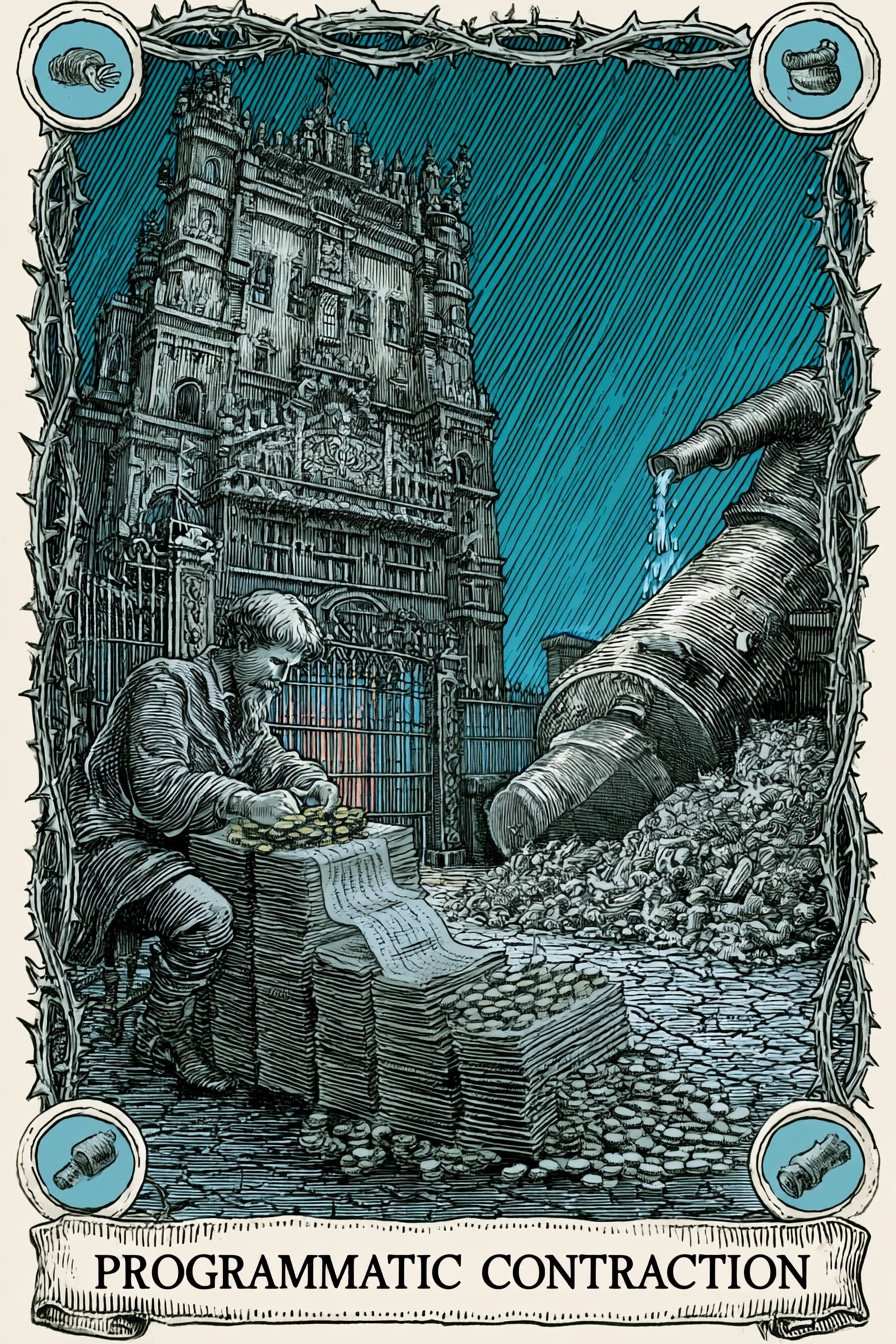
Programmatic Contraction
What does this mean?
Total revenue is stable, but the percentage of expenses spent on actual mission shrinks. Indicates administrative bloat and spending on the machinery of raising money rather than the art itself.
The Path Forward
The Rainmaker
Represents the forced release of hoarded resources back into the community. It acts as a pressure valve against administrative capture, ensuring the mission takes priority over the machine.
Title
Representative Institutions
Institutional Epochs
Historical Performance
| Year | Revenue | Top Comp | Comp % Rev | Score | Phase Label | Outlook | Details |
|---|---|---|---|---|---|---|---|
| 2018 | — | — | — | 41 | Fragile | Recovery | |
| 2017 | — | — | — | 37 | Financially Distressed | Recovery | |
| 2016 | — | — | — | 31 | Critical Intervention Needed | Decline Risk | |
| 2015 | — | — | — | 39 | Financially Distressed | Recovery | |
| 2014 | — | — | — | 37 | Financially Distressed | Decline Risk | |
| 2013 | — | — | — | 43 | Financially Distressed | Stable Watch | |
| 2012 | — | — | — | 43 | Fragile | Stable Watch | |
| 2011 | — | — | — | 43 | Fragile | Stable Watch |
Officer compensation history
No IRS 990 Part VII compensation data available for this organization.
Score breakdown
The three components combine into a single 0–100 score weighted as shown. Full methodology →
Peer comparison
Compared to 148 other orgs in AZ with NTEE prefix A6.
Most-divergent component: program score sits 27 points below the peer median (5 vs. 32).
5-year trend: Programmatic Contraction
Total revenue is stable, but the percentage of expenses spent on actual mission shrinks. Indicates administrative bloat and spending on the machinery of raising money rather than the art itself.
Overall score has gone from 37 → 41 over 5 years (improving by 4 points).
What's driving this score
- All-volunteer org with no paid officers — governance signal is neutral (default 50), not absent.
- Two consecutive years of deficit spending.
What would change this score
The two changes that would most improve this score:
- Stabilize program expenses or grow earned-income revenue to break the consecutive-deficit pattern (~8 points to financial score).
Improving governance is a board decision. These are the levers.