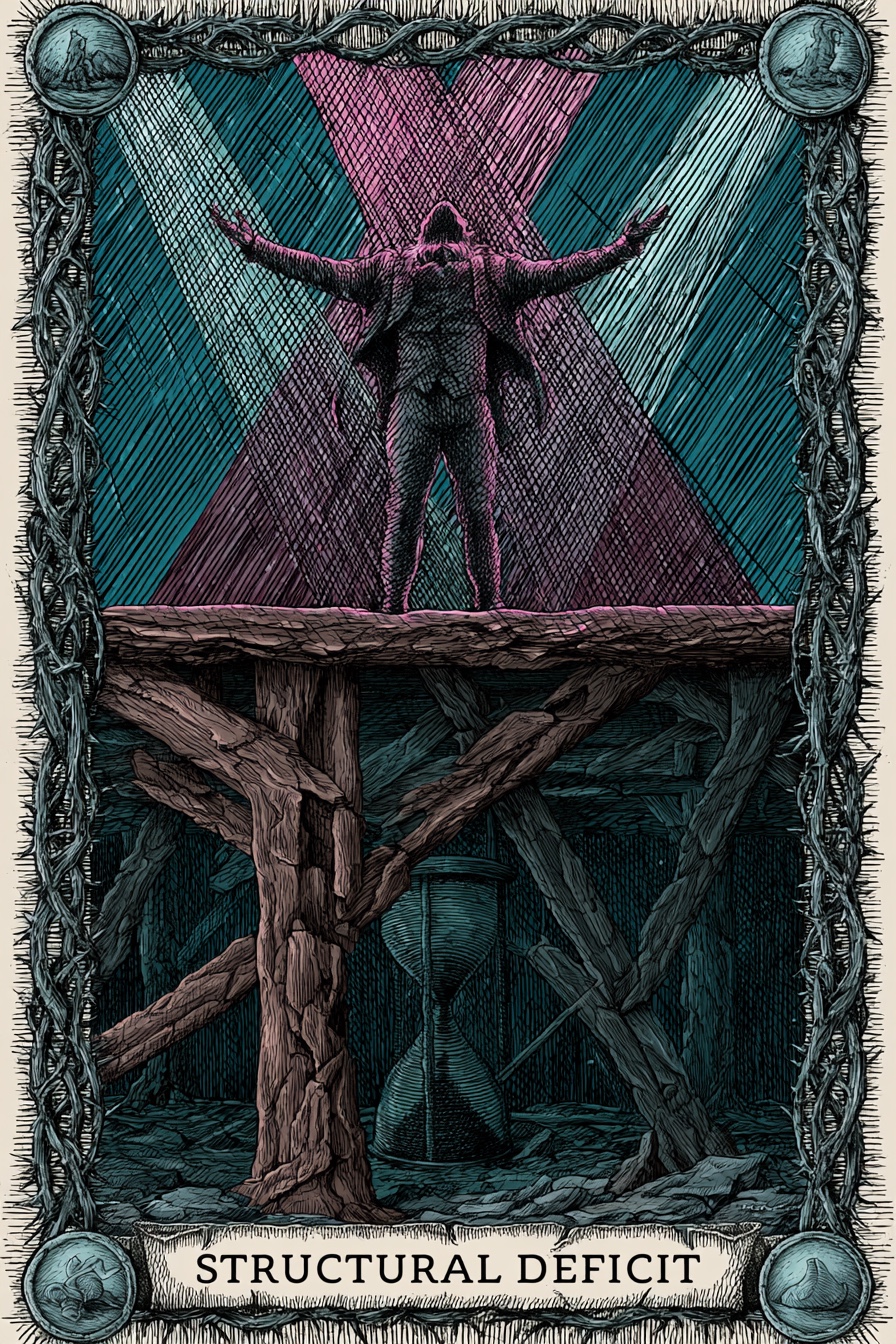
Structural Deficit
What does this mean?
Persistently low financial health over 5 years despite strong programmatic output. They are borrowing from their future (or bleeding an endowment) to pay for today's programs.
The Path Forward
The Truth-Teller
Forces necessary, painful cuts to preserve the core. It demands that the organization stop borrowing from its future and align its current programmatic output with actual sustainable revenue.

Title
Representative Institutions
Institutional Epochs
Historical Performance
| Year | Revenue | Top Comp | Comp % Rev | Score | Phase Label | Outlook | Details |
|---|---|---|---|---|---|---|---|
| 2023 | — | — | 7.5% | 34 | Critical Intervention Needed | Decline Risk | |
| 2022 | — | — | 9.3% | 38 | Financially Distressed | Recovery | |
| 2021 | — | — | 10.9% | 40 | Fragile | Recovery | |
| 2020 | — | — | 9.6% | 36 | Financially Distressed | Recovery | |
| 2019 | — | — | — | 32 | Critical Intervention Needed | Stable Watch | |
| 2018 | — | — | 13.2% | 32 | Critical Intervention Needed | Stable Watch | |
| 2017 | — | — | 8.7% | 34 | Critical Intervention Needed | Recovery | |
| 2016 | — | — | 11.9% | 32 | Critical Intervention Needed | Stable Watch | |
| 2015 | — | — | 9.1% | 30 | Critical Intervention Needed | Recovery | |
| 2014 | — | — | 11.7% | 29 | Critical Intervention Needed | Stable Watch | |
| 2013 | — | — | — | 29 | Critical Intervention Needed | Stable Watch | |
| 2012 | — | — | — | 29 | Critical Intervention Needed | Stable Watch | |
| 2011 | — | — | — | 29 | Critical Intervention Needed | Stable Watch | |
| 2010 | — | — | — | 29 | Critical Intervention Needed | Stable Watch |
Officer compensation history
Tax year 2023
| Name | Title | Phone | Compensation | |
|---|---|---|---|---|
| TATJANA BEYLOTTE | EXECUTIVE DI | 7.4% of Rev | ||
| ALVA ANDERSON | Board President | — | ||
| RONALD D MCCRAY | VICE PRESIDE | — | ||
| CLAY GRAYSON | Secretary | — | ||
| J ANTON COLLINS | Treasurer | — | ||
| JOE CLARK | Board Member | — | ||
| DEMETRIUS DOCTOR | Board Member | — | ||
| MADELEINE FRUME | Board Member | — | ||
| DONALD R JOHNSON II MD | Board Member | — | ||
| JILL JONES | Board Member | — | ||
| CLAIRE LOUDER | Board Member | — | ||
| BILL MCSWEENEY - TERM ENDED | Board Member | — | ||
| ED MEYER | Board Member | — | ||
| JOHN W OLSON | Board Member | — | ||
| MATT D PARDIECK | Board Member | — | ||
| STEVE SIMON - TERM ENDED | Board Member | — | ||
| HILTON C SMITH JR | Board Member | — | ||
| HARRY STALEY | Board Member | — | ||
| VICTOR WEINSTEIN MD | Board Member | — | ||
| RON WILTROUT | Board Member | — |
Tax year 2022
| Name | Title | Phone | Compensation | |
|---|---|---|---|---|
| TATJANA BEYLOTTE | EXECUTIVE DI | 8.0% of Rev | ||
| ALVA ANDERSON | Board President | — | ||
| RONALD D MCCRAY | VICE PRESIDE | — | ||
| CLAY GRAYSON | Secretary | — | ||
| J ANTON COLLINS | Treasurer | — | ||
| JOE CLARK | Board Member | — | ||
| DEMETRIUS DOCTOR | Board Member | — | ||
| MADELEINE FRUME | Board Member | — | ||
| DONALD R JOHNSON II MD | Board Member | — | ||
| JILL JONES | Board Member | — | ||
| CLAIRE LOUDER | Board Member | — | ||
| ED MEYER | Board Member | — | ||
| JOHN OLSON | Board Member | — | ||
| MATT D PARDIECK | Board Member | — | ||
| STEVE SIMON | Board Member | — | ||
| HILTON C SMITH JR | Board Member | — | ||
| HARRY STALEY | Board Member | — | ||
| VICTOR WEINSTEIN MD | Board Member | — | ||
| RON WILTROUT | Board Member | — |
Tax year 2021
| Name | Title | Phone | Compensation | |
|---|---|---|---|---|
| TATJANA BEYLOTTE | EXECUTIVE DI | 6.0% of Rev | ||
| ALVA ANDERSON | Board President | — | ||
| RONALD D MCCRAY | VICE PRESIDE | — | ||
| CLAY GRAYSON | Secretary | — | ||
| MATT PARDIECK | Treasurer | — | ||
| STEVE SIMON | Board Member | — | ||
| CRAIG ASCUE | Board Member | — | ||
| J ANTON COLLINS | Board Member | — | ||
| DEMETRIUS DOCTOR | Board Member | — | ||
| DONALD R JOHNSON II MD | Board Member | — | ||
| BILL MCSWEENEY | Board Member | — | ||
| JON W OLSON | Board Member | — | ||
| VICTOR WEINSTEIN | Board Member | — | ||
| RON WILTROUT | Board Member | — | ||
| ED MEYER | Board Member | — | ||
| MADELEINE FRUME | Board Member | — | ||
| JILL JONES | Board Member | — | ||
| BASIL KERR | Board Member | — | ||
| HARRY STALEY | Board Member | — | ||
| HILTON C SMITH JR | Board Member | — | ||
| DEAN SMITH | Board Member | — |
Score breakdown
The three components combine into a single 0–100 score weighted as shown. Full methodology →
Peer comparison
Compared to 129 other orgs in SC with NTEE prefix A6.
Most-divergent component: financial score sits 45 points below the peer median (0 vs. 45).
5-year trend: Structural Deficit
Persistently low financial health over 5 years despite strong programmatic output. They are borrowing from their future (or bleeding an endowment) to pay for today's programs.
Overall score has gone from 32 → 34 over 5 years (improving by 2 points).
What's driving this score
- Comp-to-revenue ratio of 7.5% sits within the sector's healthy band (18–22%).
- Financial resilience score in the bottom quartile — reserves and liabilities ratios warrant review.
What would change this score
The two changes that would most improve this score:
- Build cash reserves to at least 3 months of operating expenses — moves financial resilience score meaningfully (~10 points).
Improving governance is a board decision. These are the levers.